Saturday, July 19, 2014
FOREVER ALONE NO MORE!
I know a trick/cheat/hack whatever you want to call it on facebook. I’m giving you the chance to be forever alone no more! NO JOKE. NO SPAM. NO VIRUS. NO CODE. NO SURVEY. Totally free! (not really because there should be some tasks to prove if you deserve to get 300+ likes on your status, photos, pages, & comments to your status, photos, etc, etc.) I PROMISE THIS IS REAL. I’M NO LYING. So if you are interested. Follow me. Like this. (No need to reblog because I want it to be kind of secret. Not to be viral. iykwim) And message me. I’ll give you some tasks after. (it’s easy tasks, you’ll just need to follow me on some social nets. :) ) I’m sharing this trick because I love you. (note: i got this trick from professional hackers. so really)

Sunday, July 13, 2014
Soul theory
SOUL THEORY

So this is not my first theory but its my first legit original theory for me. tbh i just don’t know if anybody already had this but i swear i don’t anything bout that so yeah. just inform me.
This theory just struck my mind. there is no so much basis. So I guess this cant be considered as a legit theory. I am catholic but idk if our religion believes in reincarnation (i guess not) anyways. I believe in reincarnation. So for those who don’t know, reincarnation is the process where when you die, only your body dies, and your soul is transferred to a new body (probably newborn babies) and that’s how reincarnation happens. I know this sounds stupid but listen.
Well this theory is not so much stable as you are expecting to but let me just give you some statistics.
4 humans are born every second
2 humans die every second
3,000 animals die every second
300 animal babies per second
4 trees are cut per second
1 tree planted/grows per second
What is the point of this? Let me define “soul” first. Soul is define as the spiritual or immaterial part of a human being or animal, regarded as immortal. Then if its immortal then we can say that since the world was created, there were just also certain number of souls created. The number of souls is the same since the world and life is created up until now. I am theorizing that all living things has soul and the number souls present in the world never changed. Then you might be asking “if that’s the case then why human is overpopulated now?” Look at this point. Soul does not only inhabit on humans. It inhabits on all living things. How many trees and animals died over the years? Don’t you think the souls taken from it aren’t sufficient for the number of people now? So from here I can say that human is taking the souls of every living things now. This maybe an explanation why other humans behave as if they were not humans. But I’m telling you, soul is just a soul, it has no brain, so once it take its form into a new living thing, its old form has nothing to do with the new one because everything was left in it’s old thing’s brain/body. But there are also theories that there remains some parts or memories in the brain but i guess those are just the personalities but not memories. So again the number of souls didn’t changed from the very start. So the total population of all living things plus the souls just wandering around now is the total number of souls present on earth.
Start thinking now. The world isn’t populated. It is just human, taking too much souls that causes imbalance on Earth. I think we should maintain what earth was before. Vegetation abundance. Souls are just wandering anyways. It is just a cycle. A tree dies, a human is born. An animal is killed, a human is born. Therefore, it is not suitable to have a large human population because human is taking over the souls that were supposed to be for the other living things like trees and animals. (not including the bacteria, plants, algae, and just imagine the whole living things!). And if every piece of these souls were taken by human. I’m afraid it is the end of the world.
(soon. creepy huh, it ain’t far from reality. You cant deny it.)
excue my grammar. just think bout it.
Monday, May 27, 2013
Finding Teddy Guide/Walkthrough 1st level


1.Click the closet, and the girl will enter and come to a new world
2. Go to right by clicking the right most side of the ground
3. Click the golden apple. then go to left and left.
4. I f you see a monster don't click, you'll die, but you have infinite lives though, but you need to click the girl first then click the golden apple then click the monster. The monster will eat the apple.
5. Then click down, enter the cave in the left, go down, go right, right,
6. Click the blue bottle
7.Go out, by clicking left, left, up, right.
8. When you are now outside, click right, down, right, then there is a waterfall, click the girl, click the bottle then click the waterfall to get water from it.
9. Go back by going left, then up,
10. Go to right, right, right, until you see a big gray bee.(don't click it!)
11. There is a plant below it. click the girl, click the bottle with water and then click the plant.
12. The bee will give you a saw, go left , left, and then there is a hole, enter by clicking it.

13. When you are now inside, you will see a green plant at the right corner, click the girl then click the saw then click the plant.
14. Go back from where you start, by go left, left, up, right, and then from there go right, and you will see frogs. of course before you went here, you saw a frog on the left side of the tree with hole, singing notes
15. Each notes represents letter, the frog sang, H E L L O if you check it closely the notes really look like letters h, e, l, l, and o. Now. you are on the couple of frogs.
16. Click the frogs to focus it, each frog sang one note which means one letter, and then click it to spell H E L L O. In my game, click the blue first(H note), then green(E note), orange and violet (L note), red (O note)
they will go away, then click right.
17. There is a stone that has notes on it, B U G, vertically,below it, there's a hole, click the girl, click the plant then click the hole. Then a bug will came out and will be there for you to help you throughout the game.
18. Go back by clicking left, left, left, left, down, then right, right, right. Click the bug, click the feather on the top of trees.
19. Go back to the cave by clicking left, left left, left, now you're in the cave, click down, right, right, down.

20. There is a statue with two feathers on its top, click the girl, click the feather and the click he statue, it will now sing the notes. Your instrument will be unlock. It can be found in the topmost of the screen click it, you need to match the tone of the statue into the instrument. You need to know what note it is. It is actually. H A P P Y. To play the note in your instrument, you need to click the letter H (8th in first row) A(1st first row) P (7th second row) P( 7th second row) Y (7th last row/2nd from the right in last row)
21. Now go to the crying robot, by going up, left, left, left, and then the girl will automatically play the notes HAPPY, if not, then play it again, (remember! don't click the robot, it will kill you.)
22. After the HAPPY notes were played, the robot will turn to orange then it will give you a key to a locked door.
23. Go right, right, right, down, left.
24. There is a lock door, click the girl, click the key then click the lock door.
25. The girl will now enter a new level which is the Swamp.
Watch the gameplay at http://youtu.be/D_mHe3AQlW8
Friday, April 12, 2013
The World War 1 Significant things you need to know
We all know that every war, there are really those deadly weapons. Let's tackle the very first world war. And some important things about it.

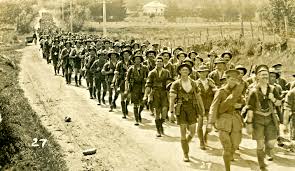


WORLD WAR 1
You can see that photos of World War 1 are still black and white because it happened many years ago.
In late June 1914, Archduke Franz Ferdinand of Austria was assassinated by a Serbian nationalist in Sarajevo, Bosnia. An escalation of threats and mobilization orders followed the incident, leading by mid-August to the outbreak of World War I, which pitted Germany, Austria-Hungary and the Ottoman Empire (the so-called Central Powers) against Great Britain, France, Russia, Italy and Japan (the Allied Powers). The Allies were joined after 1917 by the United States. The four years of the Great War--as it was then known--saw unprecedented levels of carnage and destruction, thanks to grueling trench warfare and the introduction of modern weaponry such as machine guns, tanks and chemical weapons. By the time World War I ended in the defeat of the Central Powers in November 1918, more than 9 million soldiers had been killed and 21 million more wounded. The Treaty of Versailles, signed in 1919, determined post-war borders from Europe to the Middle East, established the League of Nations as an international peace organization and punished Germany for its aggression with reparations and the loss of territory. Tragically, the instability caused by World War I would help make possible the rise of Nazi leader Adolf Hitler and would, only two decades later, lead to a second devastating international conflict.
For more information about the World war 1. Visit the website http://www.history.com/topics/world-war-i
View some of the photos of Word War.
World War One - Causes
The first world war began in August 1914. It was directly triggered by the assassination of the Austrian archduke, Franz Ferdinand and his wife, on 28th June 1914 by Bosnian revolutionary, Gavrilo Princip.
This event was, however, simply the trigger that set off declarations of war. The actual causes of the war are more complicated and are still debated by historians today.
Alliances Imperialism Militarism Nationalism Crises
Click this for more information about the causes. http://www.historyonthenet.com/WW1/causes.htm
WEAPONS
Now let's talk about the weapons they used in the World War
During World War One a variety of weapons were used.
Rifle
The main weapon used by British soldiers in the trenches was the bolt-action rifle. 15 rounds could be fired in a minute and a person 1,400 metres away could be killed.
Machine Gun
Machine guns needed 4-6 men to work them and had to be on a flat surface. They had the fire-power of 100 guns.
Large field guns had a long range and could deliver devastating blows to the enemy but needed up to 12 men to work them. They fired shells which exploded on impact.
Gas
The German army were the first to use chlorine gas at the battle of Ypres in 1915. Chlorine gas causes a burning sensation in the throat and chest pains. Death is painful - you suffocate! The problem with chlorine gas is that the weather must be right. If the wind is in the wrong direction it could end up killing your own troops rather than the enemy.
Mustard gas was the most deadly weapon used. It was fired into the trenches in shells. It is colourless and takes 12 hours to take effect. Effects include: blistering skin, vomiting, sore eyes, internal and external bleeding. Death can take up to 5 weeks.
Zeppelin
The Zeppelin, also known as blimp, was an airship that was used during the early part of the war in bombing raids by the Germans. They carried machine guns and bombs. However, they were abandoned because they were easy to shoot out of the sky.
Tank
Tanks were used for the first time in the First World War at the Battle of the Somme. They were developed to cope with the conditions on the Western Front. The first tank was called 'Little Willie' and needed a crew of 3. Its maximum speed was 3mph and it could not cross trenches.
The more modern tank was not developed until just before the end of the war. It could carry 10 men, had a revolving turret and could reach 4mph.
Planes
Planes were also used for the first time. At first they were used to deliver bombs and for spying work but became fighter aircraft armed with machine guns, bombs and some times cannons. Fights between two planes in the sky became known as 'dogfights'
Torpedoes
Torpedoes were used by submarines. The Germans used torpedoes to blow up ships carrying supplies from America to Britain.
The Germans torpedoed the passenger liner Lusitania on May 1st 1915 which sank with a loss of 1,195 lives. Americans were outraged and joined the war in 1917 on the side of the allies.
For more information. Visit the webpage http://www.historyonthenet.com/WW1/weapons.htm
And for the alliances in World WAR 1, here's a map, of the Central powers and allies.
SUMMARY OF WORLD WAR 1: TIMELINE
World War One - Timeline
| Date | Summary |
Detailed Information
|
| 28 June 1914 | Assassination of Franz Ferdinand |
The Balkan states of Bosnia and Herzegovina, had been annexed from Turkey and taken into the Austro-Hungarian Empire. This was strongly resented by many Serbs and Croats and a nationalistgroup, The Black Hand, was formed.
Archduke Franz Ferdinand of Austria, and his wife, had decided to inspect Austro-Hungarian troops in Bosnia. The date chosen for the inspection was a national day in Bosnia. The Black Hand supplied a group of students with weapons for an assassination attempt to mark the occasion.
A Serbian nationalist student, Gavrilo Princip, assassinated the Austrian Archduke Ferdinand and his wife, when their open car stopped at a corner on its way out of the town.
|
| 28 July 1914 | Austria declared war on Serbia |
The Austrian government blamed the Serbian government for the assassination of Franz Ferdinand and his wife and declared war on Serbia.
Although Russia was allied with Serbia, Germany did not believe that she would mobilise and offered to support Austria if necessary.
However, Russia did mobilise and, through their alliance with France, called on the French to mobilise.
|
| 1 Aug 1914 | Germany declared war on Russia |
Germany declared war on Russia.
|
| 3 Aug 1914 | Germany declared war on France |
Germany declared war on France. German troops poured into Belgium as directed under theSchleiffen Plan, drawn up in 1905. The British foreign secretary, Sir Edward Grey, sent an ultimatum to Germany demanding their withdrawal from the neutral Belgium.
|
| 4 Aug 1914 | British declaration of war |
Germany did not withdraw from Belgium and Britain declared war on Germany.
|
| Aug 1914 | Battle of Tannenberg |
The Russian army marched into Prussia. However, because of the differences in railway gauge between Russia and Prussia it was difficult for the Russians to get supplies through to their men. The Germans, on the other hand, used their railway system to surround the Russian Second army at Tannenberg before it's commander could realise what was happening. The ensuing battle was a heavy defeat for the Russians with thousands of men killed and 125,000 taken prisoner. Although the Germans won the battle, 13,000 men were killed.
|
| 13 Aug 1914 | Japan declared war on Germany |
Japan declared war on Germany through her alliance with Great Britain, signed in 1902
|
| Sept 1914 | Battle of Masurian Lakes |
Having defeated the Russian Second army, the Germans turned their attention to the Russian First army at Masurian Lakes. Although the Germans were unable to defeat the army completely, over 100,000 Russians were taken prisoner.
|
| 29 Oct 1914 | Turkey |
Turkey entered the war on the side of the central powers and gave help to a German naval bombardment of Russia.
|
| 2 Nov 1914 | Russia declared war on Turkey |
Because of the help given by Turkey to the German attack of Russia, Russia declared war on Turkey.
|
| 5 Nov 1914 | Britain and France declared war on Turkey |
Britain and France, Russia's allies, declared war on Turkey, because of the help given to the German attack on Russia.
|
| late 1914 | Early stages of the war |
The German advance through Belgium to France did not go as smoothly as the Germans had hoped. The Belgians put up a good fight destroying railway lines to slow the transport of German supplies.
Despite a French counter-attack that saw the deaths of many Frenchmen on the battlefields at Ardennes, the Germans continued to march into France. They were eventually halted by the allies at the river Marne.
British troops had advanced from the northern coast of France to the Belgian town of Mons. Although they initially held off the Germans, they were soon forced to retreat.
The British lost a huge number of men at the first battle of Ypres.
By Christmas, all hopes that the war would be over had gone and the holiday saw men of both sides digging themselves into the trenches of the Western Front.
|
| Dec 1914 | Zeppelins |
The first Zeppelins appeared over the English coast.
|
| 7 May 1915 | Lusitania sunk |
There outraged protests from the United States at the German U-boat campaign, when the Lusitania, which had many American passengers aboard, was sank. The Germans moderated their U-boat campaign.
|
| 23 May 1915 | Italy |
Italy entered the war on the side of the Allies.
|
| 2 Apr 1915 | Second Battle of Ypres |
Poison gas was used for the first time during this battle. The gas, fired by the Germans claimed many British casualties.
|
| Feb 1915 | Zeppelin bombing |
Zeppelin airships dropped bombs on Yarmouth.
|
| Feb 1915 | Dardenelles |
The Russians appealed for help from Britain and France to beat off an attack by the Turkish. The British navy responded by attacking Turkish forts in the Dardenelles.
|
| Apr - Aug 1915 | Dardenelles/ Gallipoli |
Despite the loss of several ships to mines, the British successfully landed a number of marines in the Gallipoli region of the Dardenelles. Unfortunately the success was not followed up and the mission was a failure.
|
| after Feb 1915 | Winston Churchill resigns |
Winston Churchill, critical of the Dardenelles campaign, resigned his post as First Lord of the Admiralty. He rejoined the army as a battalion commander.
|
| April 1915 | Zeppelins |
The use of airships by the Germans increased. Zeppelins began attacking London. They were also used for naval reconnaissance, to attack London and smaller balloons were used for reconnaissance along the Western Front. They were only stopped when the introduction of aeroplanes shot them down.
|
| early 1916 | Winston Churchill |
Winston Churchill served in Belgium as lieutenant colonel of the Royal Scots Fusiliers.
|
| April 1916 | Romania enter the war |
Romania joined the war on the side of the Allies. But within a few months was occupied by Germans and Austrians.
|
| 31 May 1916 | Battle of Jutland |
This was the only truly large-scale naval battle of the war. German forces, confined to port by a British naval blockade, came out in the hope of splitting the British fleet and destroying it ship by ship. However, the British admiral, Beatty, aware that the German tactics were the same as those used by Nelson at Trafalgar, sent a smaller force to lure the German's into the range of Admiral Jellicoe's main fleet. Although Beatty's idea worked, the exchange of fire was brief and the German's withdrew.
|
| 1 June 1916 | Battle of Jutland |
The British and German naval forces met again but the battle was inconclusive. The German ships did a great deal of damage to British ships before once again withdrawing and the British Admiral Jellicoe decided not to give chase.
Although British losses were heavier than the German, the battle had alarmed both the Kaiser and the German Admiral Scheer and they decided to keep their fleet consigned to harbour for the remainder of the war.
|
| 28 Nov 1916 | First Aeroplane raid |
The first German air raid on London took place. The Germans hoped that by making raids on London and the South East, the British Air Force would be forced into protecting the home front rather than attacking the German air force.
|
| Dec 1916 | Lloyd George Prime Minister |
Lloyd George became Prime Minister of the war time coalition. His war cabinet, unlike that of his predecessor, met every day. However, there was considerable disagreement among the members of the Cabinet, especially between Lloyd George and his war secretary, Sir Douglas Haig. Lloyd George suspected Haig of squandering life needlessly and was suspicious of his demands for more men and freedom of action in the field.
|
| 21 Feb - Nov 1916 | Battle of Verdun |
The Germans mounted an attack on the French at Verdun designed to 'bleed the French dry'. Although the fighting continued for nine months, the battle was inconclusive. Casualties were enormous on both sides with the Germans losing 430,000 men and the French 540,000.
|
| 1 July - Nov 1916 | Battle of the Somme |
The battle was preceded by a week long artillery bombardment of the German line which was supposed to destroy the barbed wire defences placed along the German line but only actually succeeded in making no mans land a mess of mud and craters. The five month long battle saw the deaths of 420,000 British soldiers (60,000 on the first day), 200,000 French soldiers and 500,000 German soldiers all for a total land gain of just 25 miles.
|
| 1917 | New war commander |
Lloyd George, who had never trusted his war minister's ability to direct the war, persuaded the Cabinet to appoint the French General Nivelle as supreme war commander over Haig's head. Haig was assured that the appointment was for one operation only and that if he felt the British army was being misused by the Frenchman he could appeal to the British government.
|
| July - Nov 1917 | W.front Passchendale |
The operation commanded by the French General, Nivelle, went wrong and caused the loss of many French soldiers. Haig protested to the British government and advocated trying his own scheme for a breakthrough. At the resulting battle of Passchendale, Haig broke his promise to call off the battle if the first stage failed because he did not want to lose face with the government.
|
| 1917 | Churchill Minister of Munitions |
Following the heavy defeat at Passchendale, Lloyd George decided that he wanted Churchill in the Cabinet. Churchill was duly appointed Minister of Munitions.
|
| 1917 | Reinforcements sent to Italy |
The Italians had lost many men trying to hold the line between Italy and the Central Powers. British and French reinforcements were sent to hold the line.
|
| early 1917 | German U-boat campaign |
In Germany, orders were given to step up the U-boat campaign. All allied or neutral ships were to be sunk on sight and in one month almost a million tons of shipping was sunk. Neutral countries became reluctant to ship goods to Britain and Lloyd George ordered all ships carrying provisions to Britain to be given a convoy.
|
| 6 April 1917 | USA declares war on Germany |
The United States of America declared war on Germany in response to the sinking, by German U boats, of US ships.
|
| Nov 1917 | W. Front Cambrai |
The British took a large force of tanks across the barbed wire and machine gun posts at Cambrai.
|
| Dec 1917 | Treaty of Brest-Litovsk |
Following the successful revolution by the Bolsheviks, the Russians signed an Armistice with Germany at Brest-Litovsk. The terms of the treaty were harsh: Russia had to surrender Poland, the Ukraine and other regions. They had to stop all Socialist propaganda directed at Germany and pay 300 million roubles for the repatriation of Russian prisoners.
|
| April 1918 | RAF formed |
The Royal Flying Corps and the Royal Naval Air Service were merged to form the Royal Air Force.
|
| 8 - 11 Aug 1918 | Battle of Amiens |
The British general, Haig, ordered the attack of the German sector at Amiens. At the same time the news came through that the allies had broken through from Salonika and forced Bulgaria to sue for peace.
|
| mid Oct 1918 | Allies recover France and Belgium |
The allies had taken almost all of German-occupied France and part of Belgium.
|
| 30 Oct 1918 | Armistice with Turkey |
The allies had successfully pushed the Turkish army back and the Turks were forced to ask for an armistice. The terms of the armistice treaty allowed the allies access to the Dardenelles.
|
| early Nov 1918 | Hindenberg line collapsed |
By the beginning of November the allies had pushed the Germans back beyond the Hindenberg line.
|
| 9 Nov 1918 | Kaiser abdicated |
Kaiser Wilhelm II abdicated.
|
| 11 Nov 1918 | Armistice signed |
At 11 am, in the French town of Redonthes, the Armistice was signed bringing the war to an end.
|
Check out this website for more information: http://www.historyonthenet.com
The end of World War 1
At 11:00 am GMT (later known as the eleventh hour of the eleventh day of the eleventh month) fighting ceased and so then World War I came to an end following an armistice with Germany. During the course of 1919 and 1920 the Allied powers signed the treaties of Versailles, Saint-Germain-en-Laye, Neuilly-sur-Seine, Trianon, and Sèvres bringing the war to an official end.
The aftermath of World War I saw drastic political, cultural, and social change across Europe, Asia, Africa, and even in areas outside those that were directly involved in the war. Four empires collapsed due to the war, old countries were abolished, new ones formed, boundaries were redrawn, international organizations were established, and many new and old ideologies took a firm hold in people's minds.
World War I also had the political effect of bringing political transformation to Germany and the United Kingdom by bringing near-universal suffrage to these two European powers, turning them into mass electoral democracies for the first time in their histories
"Force is all-conquering, but its victories are short-lived."
- Abraham Lincoln
The century following Lincoln’s assassination proved the truth of his words. The effects of World War I were a harsh reality check for Europe and other major nations of the world.
- Abraham Lincoln
The century following Lincoln’s assassination proved the truth of his words. The effects of World War I were a harsh reality check for Europe and other major nations of the world.
Decline of the Empires
The political changes effected by World War I were reflected best in the decline of the empires. While the Ottoman Empire and Austria-Hungary completely collapsed, the Great War also sounded the death knell for monarchies in Germany and Russia, which became republics. World War I was also the cause for a rise in nationalistic tendencies leading to the demand for independence in many British colonies of outside Europe.
Changing Economies and Societies
The economic strain caused by World War I resounded through Europe and the rest of the world. Inflation skyrocketed in many countries. The burden of reparations drastically affected the German economy. The value of the deutsche mark dipped to an all-time low. European nations owed their allies over $10 billion in the postwar years.
Much changed on the social front too. With the men having joined the war, the women of most countries took over businesses and establishments. Mechanization and mass production paved the way for labor laws. The disillusionment caused by war led to a revolution in many societies. People chose republics over monarchies and the desire for better standards of living were openly vented.
Much changed on the social front too. With the men having joined the war, the women of most countries took over businesses and establishments. Mechanization and mass production paved the way for labor laws. The disillusionment caused by war led to a revolution in many societies. People chose republics over monarchies and the desire for better standards of living were openly vented.
Need for the League of Nations
“A general association of nations must be formed under specific covenants for the purpose of affording mutual guarantees of political independence and territorial integrity to great and small states alike.” - President Woodrow Wilson
World War I exposed the need for an association of nations – a body to promote international peace and security. The necessity of an organization to prevent a global conflict of the nature of World War I was initially pointed out by President Woodrow Wilson in his Congressional Speech in 1918. The emergence of the League of Nations was a natural corollary to the catastrophic consequences of the Great War.
On June 25, 1919, the plan to create the League of Nations was sanctioned at the Paris Peace Conference. The initial council meeting of the League of Nations was held in Paris on January 16, 1920. The League of Nations headquarters was moved to Geneva in November 1920. The League's inaugural General Assembly was attended by forty-one nations on November 15, 1920.
Despite being the brainchild of President Woodrow Wilson, the United States did not join the League of Nations, as it was not ratified by the U.S. Congress.
World War I exposed the need for an association of nations – a body to promote international peace and security. The necessity of an organization to prevent a global conflict of the nature of World War I was initially pointed out by President Woodrow Wilson in his Congressional Speech in 1918. The emergence of the League of Nations was a natural corollary to the catastrophic consequences of the Great War.
On June 25, 1919, the plan to create the League of Nations was sanctioned at the Paris Peace Conference. The initial council meeting of the League of Nations was held in Paris on January 16, 1920. The League of Nations headquarters was moved to Geneva in November 1920. The League's inaugural General Assembly was attended by forty-one nations on November 15, 1920.
Despite being the brainchild of President Woodrow Wilson, the United States did not join the League of Nations, as it was not ratified by the U.S. Congress.
Technological Growth
The one distinct positive outcome of World War I was the boost received by research and technology. Rail and automobile transport, radio and wireless communications, research and development of weapons and arms, including nuclear research, boomed. The years following World War I saw unprecedented armament and chemical research. The atomic bombs used in World War II were developed in the period following the Great War. Aviation technology, quite literally, took off. Machines of mass production, developed during the war, revolutionized industries in the postwar years.
Did World War I cause World War II?
"This is not peace. It is an armistice for 20 years." - Ferdinand Foch, Maréchal de France
As Foch rightly remarked, the Treaty of Versailles was the cause of much dissent in Europe. While Germany had based the armistice on President Wilson’s Fourteen Points, the Treaty of Versailles had none of the idealism he had envisioned. The harsh terms of the treaty placed all responsibility of the Great War on Germany. The financial reparations paid by the Central Powers caused much resentment. Although, World War I was by no means the only reason for the outbreak of World War II, the settlement of territories, responsibility, and finances only led to more strife which eventually translated into World War II.
As Foch rightly remarked, the Treaty of Versailles was the cause of much dissent in Europe. While Germany had based the armistice on President Wilson’s Fourteen Points, the Treaty of Versailles had none of the idealism he had envisioned. The harsh terms of the treaty placed all responsibility of the Great War on Germany. The financial reparations paid by the Central Powers caused much resentment. Although, World War I was by no means the only reason for the outbreak of World War II, the settlement of territories, responsibility, and finances only led to more strife which eventually translated into World War II.
World War 3, Is it really coming?
Whats with the world now? Is there will be a upcoming World War 3? First let us first know what's happening now. View the news. Here's a site you can view up to. http://www.worldwar3news.com/
And the Head news is this.
As the reclusive state prepares another imminent missile launch, a professor with the Chinese Communist Party has warned that there is a 70-80% chance of war with North Korea.

Image: Flickr/Daniel Foster
“There is a 70 to 80 per cent chance that a war will happen because North Korean leader Kim Jong-un may want to use this opportunity to force a reunification of the Korean Peninsula,” Zhang Liangui, a professor of international strategic research at the Communist Party’s Central Party School, told the South China Morning Post.
“The longer we delay fixing it, the more difficult the situation will become,” he added. “China needs to seriously consider how to tackle the problem.”
Liangui’s comments arrive in the aftermath of speculation that China is becomingincreasingly exacerbated with its belligerent ally and is looking to shift away from the Hermit kingdom. In February, a deputy editor of a newspaper affiliated with the Central Party School was suspended for writing a Financial Times piece in which he urged China to abandon North Korea.
Observers are expecting another North Korean missile launch within days as reports emerge that rockets have been move into the firing position. South Korea has said that its missile defense system will intercept the rockets if they are aimed at South Korean territory.
US Defense Secretary Chuck Hagel told reporters yesterday that America “is fully prepared to deal with any contingency, any action that North Korea may take or any provocation that they may instigate,” adding that Kim Jong-un was “skating close to a very dangerous line.”
Last month, North Korea threatened to launch “all out nuclear war,” aimed at the United States and South Korea.
While tensions with North Korea continue to build, financial experts are also predictingthat a new world war is on the horizon due to a number of economic factors.
“All too often war is the manifestation of simple economic entropy played to its logical conclusion. We believe that war is an inevitable consequence of the current global economic situation,” writes Karl Bass.
Former Goldman Sachs technical analyst Charles Nenner also warned of “a major war starting at the end of 2012 to 2013,” which will crash the stock market .
Billionaire investor Jim Rogers is also predicting that continued bailouts in Europe “could ultimately spark another world war.”
*********************
Paul Joseph Watson is the editor and writer for Infowars.com and Prison Planet.com. He is the author of Order Out Of Chaos. Watson is also a host for Infowars Nightly News.
Sunday, July 29, 2012
Where's your intelligent?
[ search? copy paste? where is your brain now? ]
GOOGLE HAS IT. FACEBOOK HAS IT. TWITTER HAS IT. INTERNET HAS IT.
COMPUTER HAS IT.
Many people now are addicted in internet. its not surprising, because of influences they got from powerful, rich people in the world. in fact, we don't need them all. Why do we need to have a lot of INNOVATIONS for computers? cellphones, why not just one? It is because, they have the influence, we have the money. we keep on buying the latest gadgets, but the truth, all of it are the same purpose. In the end, they get rich, you get poor and dumb.
I hope people can see the real business in the world. Stop capitalism. But if you wan't to be a fool, Im not stopping you.
Friday, July 13, 2012
Friday the 13th
Friday the 13th is considered an unlucky day in Western superstition.
History

According to folklorists, there is no written evidence for a "Friday the 13th" superstition before the 19th century.[1][2][3] The earliest known documented reference in English occurs inHenry Sutherland Edwards' 1869 biography of Gioachino Rossini, who died on a Friday 13th.
He [Rossini] was surrounded to the last by admiring friends; and if it be true that, like so many Italians, he regarded Fridays as an unlucky day and thirteen as an unlucky number, it is remarkable that one Friday 13th of November he died.[4]
Several theories have been proposed about the origin of the Friday the 13th superstition.
One theory states that it is a modern amalgamation of two older superstitions: that thirteenis an unlucky number and that Friday is an unlucky day.
- In numerology, the number twelve is considered the number of completeness, as reflected in the twelve months of the year, twelve hours of the clock, twelve gods of Olympus, twelve tribes of Israel, twelve Apostles of Jesus, the 12 successors of Muhammad in Shia Islam, twelve signs of the Zodiac, etc., whereas the number thirteen was considered irregular, transgressing this completeness. There is also a superstition, thought by some to derive from the Last Supper or a Norse myth, that having thirteen people seated at a table will result in the death of one of the diners.
- Friday has been considered an unlucky day at least since the 14th century's The Canterbury Tales,[5] and many other professions have regarded Friday as an unlucky day to undertake journeys or begin new projects.
- One author, noting that references are all but nonexistent before 1907 but frequently seen thereafter, has argued that its popularity derives from the publication that year of Thomas W. Lawson's popular novel Friday, the Thirteenth,[6] in which an unscrupulousbroker takes advantage of the superstition to create a Wall Street panic on a Friday the 13th.[1]
- Records of the superstition are rarely found before the 20th century, when it became extremely common. The connection between the Friday the 13th superstition and the Knights Templar was popularized in Dan Brown's 2003 novel The Da Vinci Code and in John J. Robinson's 1989 work Born in Blood: The Lost Secrets of Freemasonry. On Friday, 13 October 1307, hundreds of the Knights Templar were arrested in France, an action apparently motivated financially and undertaken by the efficient royal bureaucracy to increase the prestige of the crown. Philip IV was the force behind this ruthless move, but it has also tarnished the historical reputation of Clement V. From the very day of Clement V's coronation, the king falsely charged the Templars with heresy, immorality and abuses, and the scruples of the Pope were compromised by a growing sense that the burgeoning French State might not wait for the Church, but would proceed independently. [7] However, experts agree that this is a relatively recent correlation, and most likely a modern-day invention.[5][8][9]
[edit]Phobia names and etymology
The fear of Friday the 13th has been called friggatriskaidekaphobia (Frigga being the name of the Norse goddess for whom "Friday" is named and triskaidekaphobia meaning fear of the number thirteen), or paraskevidekatriaphobia[10][11] a concatenation of the Greekwords Paraskeví (Παρασκευή, meaning "Friday"), and dekatreís (δεκατρείς, meaning "thirteen") attached to phobía (φοβία, from phóbos, φόβος, meaning "fear"). The latter word was derived in 1911[citation needed] and first appeared in a mainstream source in 1953.[12]
[edit]Tuesday the 13th
In Spanish-speaking countries, instead of Friday, Tuesday the 13th (martes trece) is considered a day of bad luck.[13]
The Greeks also consider Tuesday (and especially the 13th) to be an unlucky day. Tuesday is considered to be dominated by the influence of Ares (Mars), the god of war. A connection can be seen in the etymology of the name in some European languages (Mardi in French or martes in Spanish). The Fall of Constantinople to the Ottomans happened on Tuesday, May 29, 1453, fact that strengthens the superstition about Tuesday. In addition, in Greek the name of the day is Triti (Τρίτη) meaning literally the third (day of the week), adding weight to the superstition, since bad luck is said to "come in threes".
[edit]Friday the 17th
In Italian popular culture, Friday the 17th (and not the 13th) is considered a day of bad luck.[14] In fact, in Italy, 13 is generally considered a lucky number.[15] However, due to Anglo-Saxon influence, young people consider Friday the 13th to be unlucky as well.[16]
The 2000 parody film Shriek If You Know What I Did Last Friday the Thirteenth was released in Italy with the title Shriek – Hai impegni per venerdì 17? ("Shriek – Do You Have Something to Do on Friday the 17th?").
[edit]Social impact
According to the Stress Management Center and Phobia Institute in Asheville, North Carolina, an estimated 17 to 21 million people in the United States are affected by a fear of this day making it the most feared day and date in history. Some people are so paralyzed by fear that they avoid their normal routines in doing business, taking flights or even getting out of bed. "It's been estimated that [US]$800 or $900 million is lost in business on this day".[2] Despite this, representatives for both Delta Air Lines and Continental Airlines say that their airlines do not suffer from any noticeable drop in travel on those Fridays.[17]
[edit]Rate of accidents
The Dutch Centre for Insurance Statistics (CVS) on June 12, 2008, stated that "fewer accidents and reports of fire and theft occur when the 13th of the month falls on a Friday than on other Fridays, because people are preventatively more careful or just stay home. Statistically speaking, driving is slightly safer on Friday the 13th, at least in the Netherlands; in the last two years, Dutch insurers received reports of an average 7,800 traffic accidents each Friday; but the average figure when the 13th fell on a Friday was just 7,500."[18][19]
[edit]Occurrence
The following months have a Friday the 13th:
| Month | Years | Dominical letter |
|---|---|---|
| January | 1978, 1984, 1989, 1995, 2006, 2012, 2017, 2023 | A, AG |
| February | 1976, 1981, 1987, 1998, 2004, 2009, 2015, 2026 | D, DC |
| March | 1981, 1987, 1992, 1998, 2009, 2015, 2020, 2026 | D, ED |
| April | 1973, 1979, 1984, 1990, 2001, 2007, 2012, 2018 | G, AG |
| May | 1977, 1983, 1988, 1994, 2005, 2011, 2016, 2022 | B, CB |
| June | 1975, 1980, 1986, 1997, 2003, 2008, 2014, 2025 | E, FE |
| July | 1973, 1979, 1984, 1990, 2001, 2007, 2012, 2018 | G, AG |
| August | 1976, 1982, 1993, 1999, 2004, 2010, 2021, 2027 | C, DC |
| September | 1974, 1985, 1991, 1996, 2002, 2013, 2019, 2024 | F, GF |
| October | 1978, 1989, 1995, 2000, 2006, 2017, 2023, 2028 | A, BA |
| November | 1981, 1987, 1992, 1998, 2009, 2015, 2020, 2026 | D, ED |
| December | 1974, 1985, 1991, 1996, 2002, 2013, 2019, 2024 | F, GF |
This sequence given here for 2001–2028, follows a 28-year cycle from March 1, 1900 to February 28, 2100. The months with a Friday the 13th are determined by the Dominical letter (G, F, GF, etc.) of the year. Every month that begins on a Sunday will contain a Friday the 13th, and there is at least one Friday the 13th in every calendar year.
The longest period that can occur without a Friday the 13th is fourteen months, either from July to September the following common year (e.g. between 2001–02, 2012–13, and 2018–19), or from August to October the following leap year (e.g. between 1999–2000 or 2027–28).
Friday the 13th can occur as many as three times in a single year; either in February, March and November in an ordinary year (such as 2009), or January, April and July in leap years (such as 2012).
Patterns for common years:
Each Gregorian 400-year cycle contains 146,097 days (365 × 400 = 146,000 normal days, plus 97 leap days). 146,097 ÷ 7 = 20,871 weeks. Thus, each cycle contains the same pattern of days of the week (and thus the same pattern of Fridays that are on the 13th). The 13th day of the month is slightly more likely to be a Friday than any other day of the week.[20] On average, there is a Friday the 13th once every 212.35 days (compared to Thursday the 13th, which occurs only once every 213.59 days).
The distribution of the 13th day over the 4,800 months is as follows:
[edit]Events on Fridays the 13th
Some events are intentionally scheduled for Fridays the 13th for dramatic effect. They include:
Events that have occurred on Friday the 13th include:
Note that this list of events may be subject to confirmation bias.
[edit]Notable people who died on Friday the 13th
FROM WIKIPEDIA: http://en.wikipedia.org/wiki/Friday_the_13th |

Subscribe to:
Posts (Atom)